
[Apologies: wrote this last week and neglected to post here!]
A very common question many of us are asking these days is, what can I do? Well, I have an answer: you can do your part.
At the end of the book of Exodus, which we read this past Shabbat, we read about the final steps in the construction of the Tabernacle. The Torah up until this point has spent a lot of ink describing in great detail the Tabernacle, the portable structure that will become the center of communal and spiritual life for the Israelite community as they make their way to the Promised Land.
We are first introduced to the description of the Tabernacle earlier in the book as God relays the Torah to Moses on Mount Sinai—God gives materials, measurements, and method for constructing this building. Then, the Torah repeats this description as it relates the actual construction of the Tabernacle, led by Betzalel and a team of artisans. Now, in this week’s parasha, we have another repetitive description as God first describes the order for assembling the pieces, and then Moses does it. Once completed, the cloud of God descends.
It’s important to remember that Betzalel and his team made the parts, and Moses put those parts together. Imagine a Lego set or a piece of IKEA furniture—all the pieces are laid out and we need to follow the instructions to put it together. The same principle is at work, only with bigger pieces and more at stake.
But again, why such detail as to all the parts and pieces of the Tabernacle throughout the book of Exodus? We only get the answer at the end when it is completed—we are given such detail to remind us that each and every part is important and vital to the whole. Just as missing pieces in the Lego set or the IKEA furniture can result in it looking strange or incongruous, or, at worst, falling apart, the Tabernacle would not “work” if all the pieces were not in place. If anything was missing, the cloud of God would not descend, and the Israelites could not continue on their journey of liberation.
And here we are facing our contemporary challenges, needing to set off on new journeys of liberation. And in these movements too, there are a lot of necessary parts, and all of those parts must work together to bring about the desired result.
So back to the question: What can you do? You can do your part.
What that is, though, is for you to decide and figure out. How much time do you have? What are your skills? Whatever you have to contribute, no matter how large or small, is important and necessary. Are you the plank making up the protective boundary of the Tabernacle? Are you the pole that helps carry the Ark of the Covenant? Are you the laver that washes and heals the priests? Are you part of the altar, that facilitates communication with God? All of these parts are important to the functioning of the Tabernacle, none is more central than another.
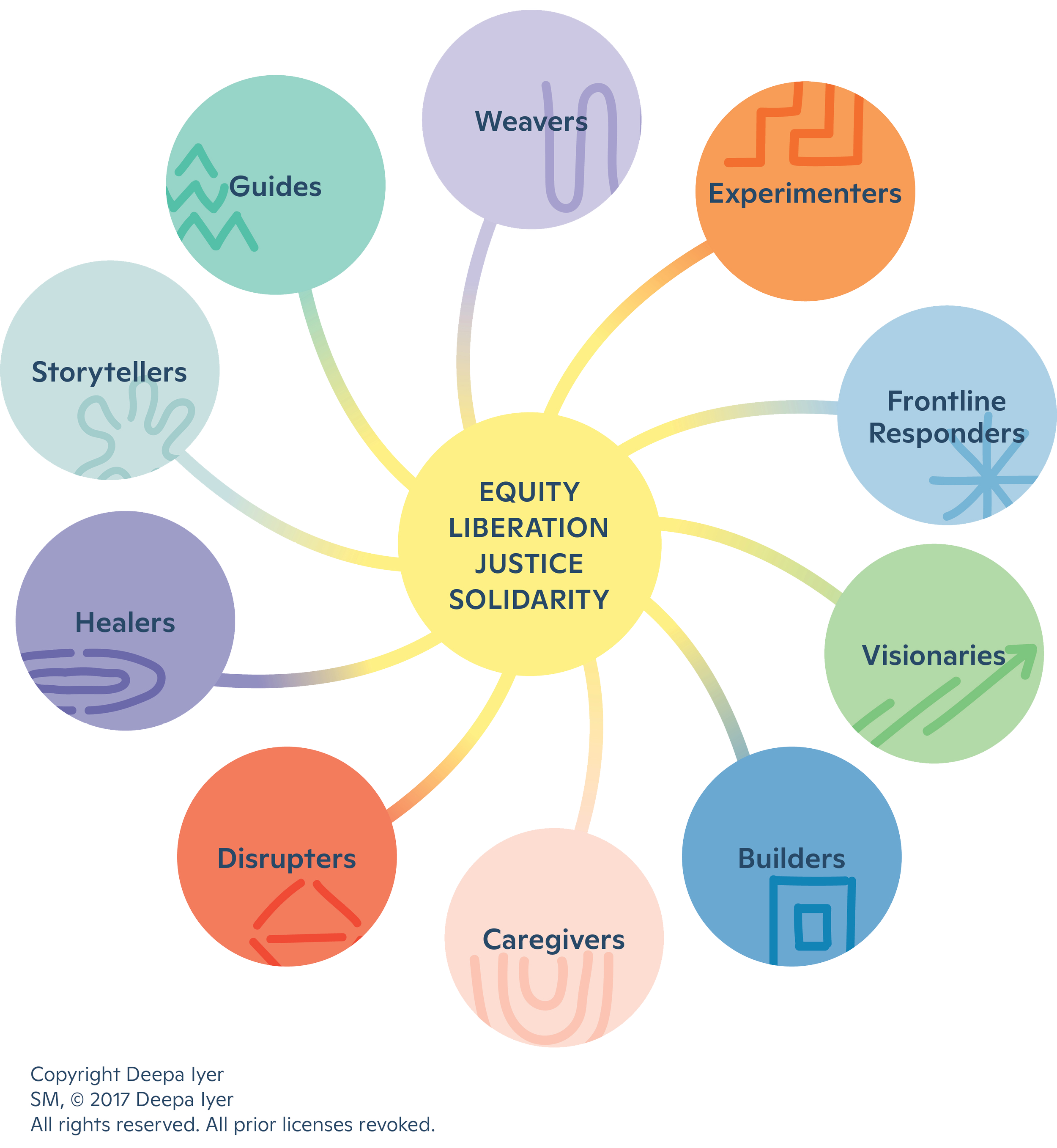
[A helpful way of thinking about this for social movements is the Social Movement Ecosystem developed by Deepa Iyar. There are many different functions and roles that need to happen for successful movements, and one person can not do it all. An individual might find themselves playing more than one of these roles, but not all of them. But ultimately, everyone together fills them all. See also ]
It is fitting that the day the Tabernacle was set up was the “first day of the first month,” (Exodus 40:17) which is the beginning of the month of Nissan. (Rosh Chodesh Nissan, the new moon of Nissan, is Sunday.) While we celebrate the new year in the fall, the month of Tishrei when Rosh Hashanah falls is actually the seventh month of the year. (This was something that would always confuse me in Hebrew school.) We mark time in different ways in our tradition. Rosh Hashanah marks the anniversary of the creation of the world, and thus the new year. But we mark the counting of months from the liberation of Egypt and the story of the Exodus, the creation of a new people, as it were. And as Nissan is also seen as the beginning of spring and Passover, which we will celebrate in two weeks, a springtime festival, this is a time ripe with potential and possibility.
This is a season of transformation. The building of the Tabernacle was a vital step in the maturation of the community. In the timeline of the Torah, the Israelites were marking the second anniversary of the Exodus—which set that process in motion—when the Tabernacle was completed. And now we are marking that anniversary this month.
So as with Passover, when we are meant to remember the Exodus and apply its themes of liberation to our time, we can also remember the building of the Tabernacle and the themes it teaches: everyone plays a part, and every part—large or small, regardless of function—is important and necessary for the whole.
Find your part. We can’t do it without you.


Thanks for continuing the conversation!