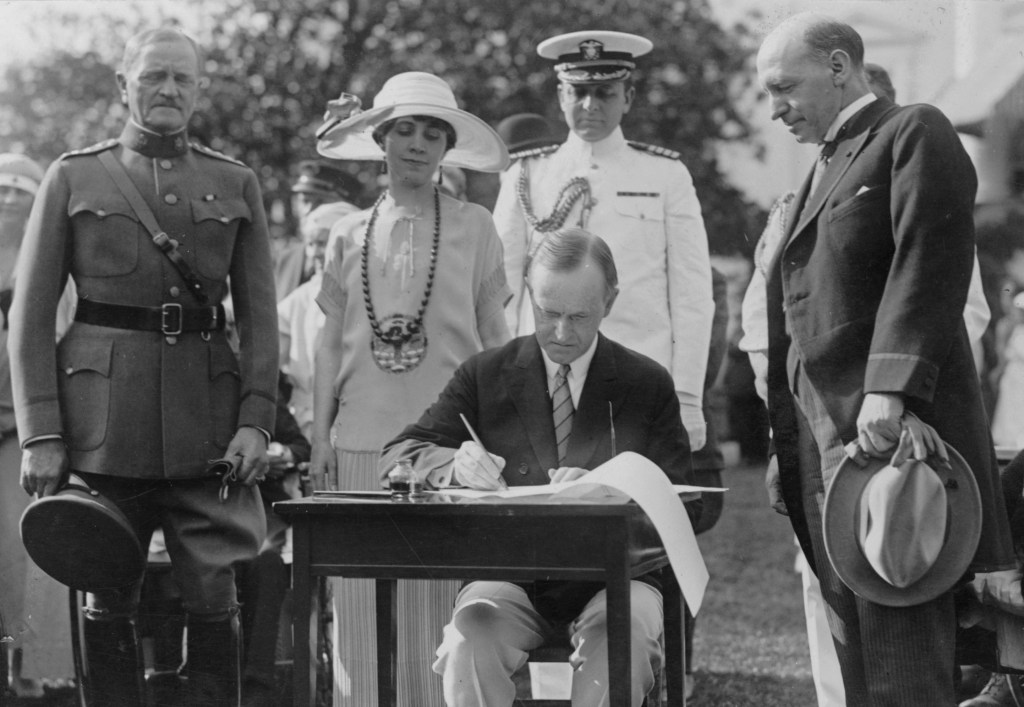
A century ago today, one of the most restrictive immigration measures in US history was signed into law. The bill, known formally as the Immigration Act of 1924 but also as the Johnson-Reed Act, closed the door to immigration for all Asians, and instituted a quota system that severely limited immigration from Central and Eastern Europe, including many, many Jews. The bill was signed by President Calvin Coolidge on May 24, 1924.
Like many Jews in the United States, I trace my ancestry to Eastern Europe and the waves and waves of intrepid immigrants who travelled by ship across the Atlantic in the early part of the 20th century. It is a part of my family story and my personal identity. It is why issues of immigration loom so large in my consciousness and in the consciousness of so many in the American Jewish community.
Not only do our own personal stories of immigration resonate, but so do our shared sacred stories. The Torah’s story of the Exodus–which we recently retold and celebrated around the Passover Seder table–is a story the migration of refugees. We also heed the charge, repeated often in the Torah, to be welcoming to “the stranger” because we were strangers in the land of Egypt.
And so in recent history, eight years ago, when talks of “building a wall” and “Muslim bans” became prevalent before and after the election of the previous President (and is a potential reality again along with promises of mass deportations), many Jewish individuals, and our congregation Temple Beth Hatfiloh as a whole, rose up and took action. In response to this anti-immigrant sentiment, we held vigils, learning sessions, talks by attorneys, and theater performances. I took a rabbinic trip to the border with HIAS and T’ruah to see conditions of immigrants and asylum seekers first hand. And eventually, after much discernment and hard work, we became a Sanctuary Congregation, welcoming a woman and child seeking asylum to live in our building.
This was the work that called us; we felt it in our spirits and our bones. It was the act of tikkun olam (“repair of the world”) that we knew we needed to do.
I also like to think that it was an act of tikkun (“repair”) for our South Sound community, whether we knew it or not. For while our contemporary elected officials paved the way for our work and demonstrated their support for immigrant justice by declaring Olympia a Sanctuary City, a century ago the story was different.
In 1924 the “Johnson” of the Johnson-Reed Act was Representative Albert Johnson of the State of Washington. And within our state, Johnson represented the 3rd District, which, at that time, included Olympia. It was our own Congressman therefore who led the charge to restrict immigration and close our borders. It was our own Congressman whose actions forced Jews, and many others, to suffer.
I remember learning this as I reacquainted myself with US immigration history as we engaged in our congregational work on immigration. I learned that Johnson was born in Illinois and as an adult made his way first to Tacoma and then to Hoquiam where he worked as a newspaper editor. He was first elected to Congress in 1913 and served until 1933. I learned he was a nativist, a racist, and a eugenicist, which drove his anti-immigrant stance and compelled him to author and push this legislation.
The law’s restriction on Asians and use of a quota system was bad enough, but the way the quota system was implemented was particularly nefarious. The US had first introduced a quota system in 1921, and the Johnson-Reed Act modified those quotas by basing them not on the most recent 1920 census, but on the census of 1890, before the large waves of Jewish and other immigration from Eastern Europe. The use of this standard was to purposefully increase immigration from Northern and Western Europe and decrease immigration from Central and Eastern Europe. Thus the quotas intentionally forced Jews to languish in Europe. And we know all to well the fate, less than two decades later, of those left behind.
Indeed, Hitler himself was inspired by and praised the Johnson-Reed Act as well as other eugenics-based and race-based laws in the United States.
The quotas were modified in 1927, but still had the effect of keeping out Jews, especially as they fled Nazi Europe. US immigration law wouldn’t abolish them until 1965. Johnson had died a few years prior, in 1957. He never saw his quotas overturned.
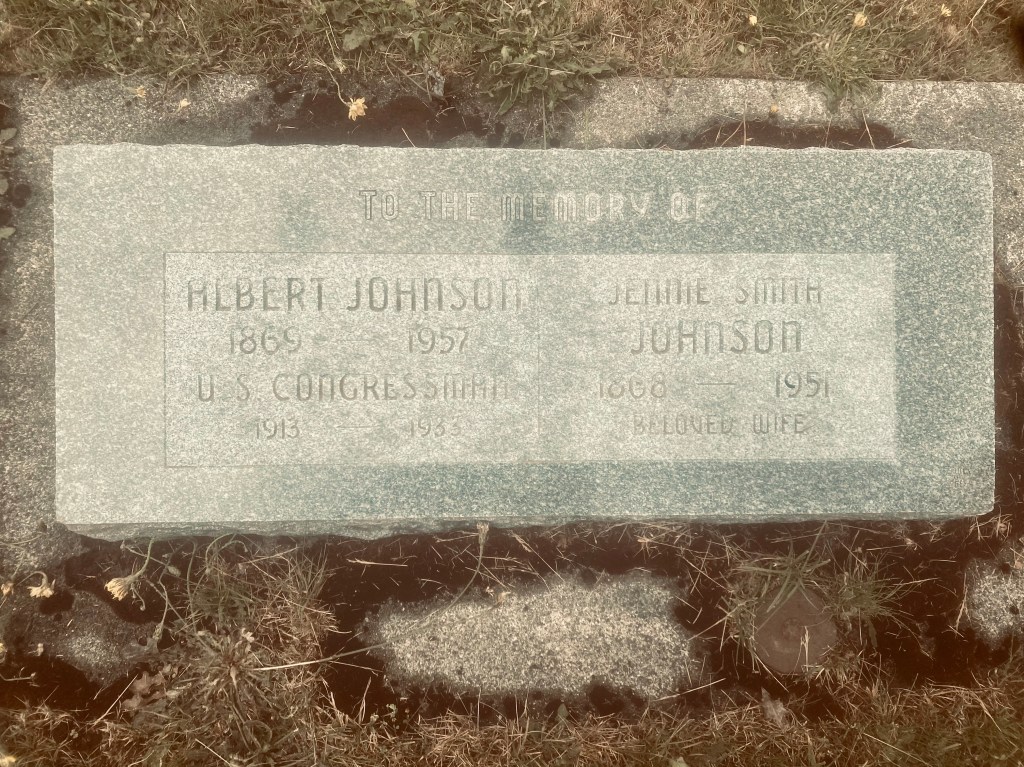
Johnson is buried at Sunset Memorial Park in Hoquiam, and at one point I felt intrigued to visit his gravesite. After some searching I finally found it, a simple memorial to someone who caused such outsized pain and suffering to so many, who marshalled forces of hate and fear to exclude, who championed pseudo-science and “purity” over compassion and diversity.
As we note this ignominious anniversary, we must remain committed as individuals and as a congregation to immigrant justice through advocacy and acts of service. [I am honored to have been invited to Washington, DC to lobby on behalf of HIAS in two weeks.] This is the important work of Olympia Jews: to honor our personal stories, to live into our sacred texts, and to redeem and repair our community’s legacy of xenophobia.


 Rabbi 360
Leave a reply to Linda Malanchuk-Finnan Cancel reply