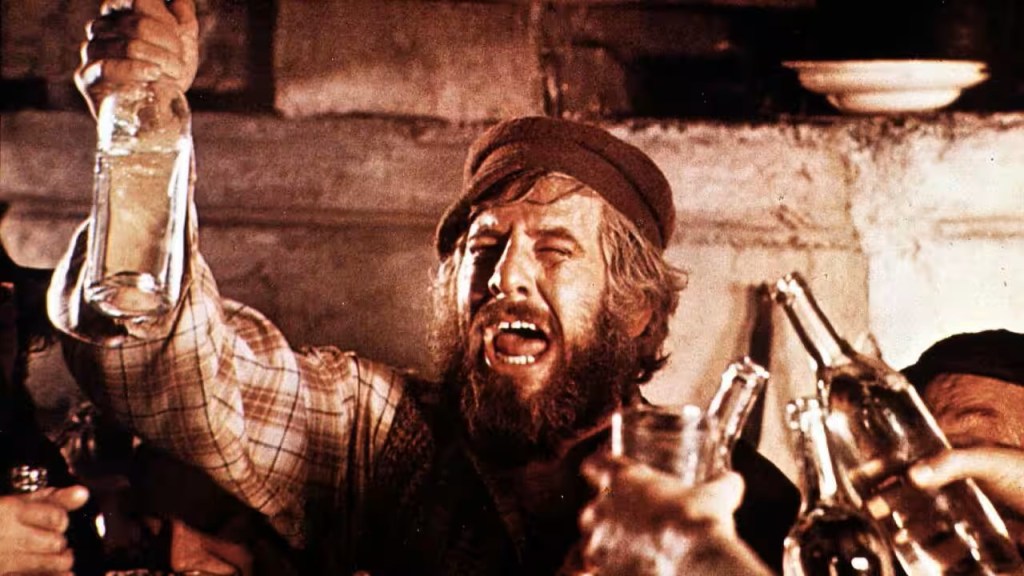
I watch “Fiddler on the Roof” at least once a year, usually on Christmas Day when my congregation partners with our local independent cinema to show the 1971 classic.
The film, an adaptation of the Broadway musical which is an adaptation of short stories of Sholom Aleichem, tells the story of Tevye, a dairyman in the (fictitious) Jewish Eastern European shtetl of Anatevka, as he confronts changing times and the onset of modernity. Throughout the course of the film he has three daughters eschew “tradition” and choose whom to marry (one a traditional Jew, one a modern, “revolutionary” Jew, and one a non-Jew). He also must navigate the presence of the Russian townspeople and ruling authorities.
I find Fiddler to be a profound piece of work, not only for its important themes set against a wonderful score, but also how it reflects the identity of Jewish creators who made it and how its idioms and music has entered into the contemporary Jewish lexicon. (We—unironically—had “Sunrise, Sunset” sung at our wedding.)
Since I watch it once a year, it serves a bit like the reading of the Torah, which we do each week every year. Like with the Torah, the film doesn’t change, but I do, and something different stands out to me each year. A few years ago, as my wife and I marked 25 years of marriage, the song “Do You Love Me,” with its observation of love and commitment over a long period of time was resonant. As I face the coming wedding of one of my own children, “Sunrise, Sunset” will once again come to mind.
This year, however, it was “L’chaim (To Life)” and its staging that made me sit up straight.
The song takes place in a tavern on a Saturday evening after Shabbat. Tevye has just made an agreement that the widower butcher Lazar Wolf will marry Tevye’s oldest daughter Tzeitel, and they head out to celebrate. Toasting with their friends, they dance and sing a song of joy and the hope for current and future happiness.
Midway through the song they are interrupted by several of the Russian villagers. They too break into song, offering congratulations and blessing to their Jewish neighbors. The song ends with the two groups singing and dancing together in a demonstration of unity and mutual coexistence.
Or does it?
Two things stood out to me watching it this year. First, we laugh at Tevye’s reluctance to take the hand of the Russian villager, how he first rubs his beard and then takes only the fingertips, before getting more comfortable and joining fully in the dance.
But if we look beyond Tevye, we can see the abject fear and terror in his face and the faces of some of the other Jewish villagers, and their participation feels less about shared joy than about pragmatic protection. Lazar Wolf, for one, backs away and refuses to participate. The clapping and stomping of the Russians feel less like joy, and more like a threat disguised as joy.
And this is reinforced by the other thing that stood out, a subtle act of choreography and staging. (Whether Jerome Robbins meant this I do not know.) When the Russian villager holds out his his hand to Tevye, he is not offering to join in the Jewish dance, but he is inviting (demanding?) the Jews join in the Russian dance. Which they do.
Eventually the two dances join together, but not without a back and forth. At one point the Russians move in and out between the Jewish characters whose hands are linked in a circle dance. They wind up dancing together, but it hardly seems mutual.
Which is reinforced immediately following this song as this is the moment in the story when the Constable tells Tevye that there will be a “little, unofficial demonstration”—a euphemism for a pogrom. And it was during that conversation that we hear the most explicit antisemitic piece of dialogue in the film spoken by the Constable: “You are an honest, decent person, even if you are a Jew.”
“L’chaim (To Life)” stood out to me this year because it demonstrates something I have been thinking about as one of the defining aspects of the Jewish experience: that our existence has been, and perhaps will always continue to be, conditional. We will only be accepted if we acquiesce to the ideas, opinions, behaviors—and dances—of the majority. That we will continue to be divided between the “good Jews” and the “bad Jews”—and we will continue to try to put ourselves in the right category for the right people in order to be acceptable.
In the story, just as the warning for the impending pogrom comes after the celebration of an engagement, the actual pogrom comes during the wedding celebration itself. Tevye learns that even his cordial relationships with the ruling authorities are not enough to save him. Eventually, as we see at the end of the show, all the Jewish residents are expelled from their town. They will need seek acceptance in another place.
“Fiddler” persists I think for a variety of reasons: it is a nostalgic retelling of many of our Jewish pasts and stories of migration, and it shares the universal themes of the struggle with identity, tradition, and change. And, at the same time, “Fiddler” also shares truths about Jewish existence that both overshadow that halcyon past, and define a very real present.

 Rabbi 360
Thanks for continuing the conversation!