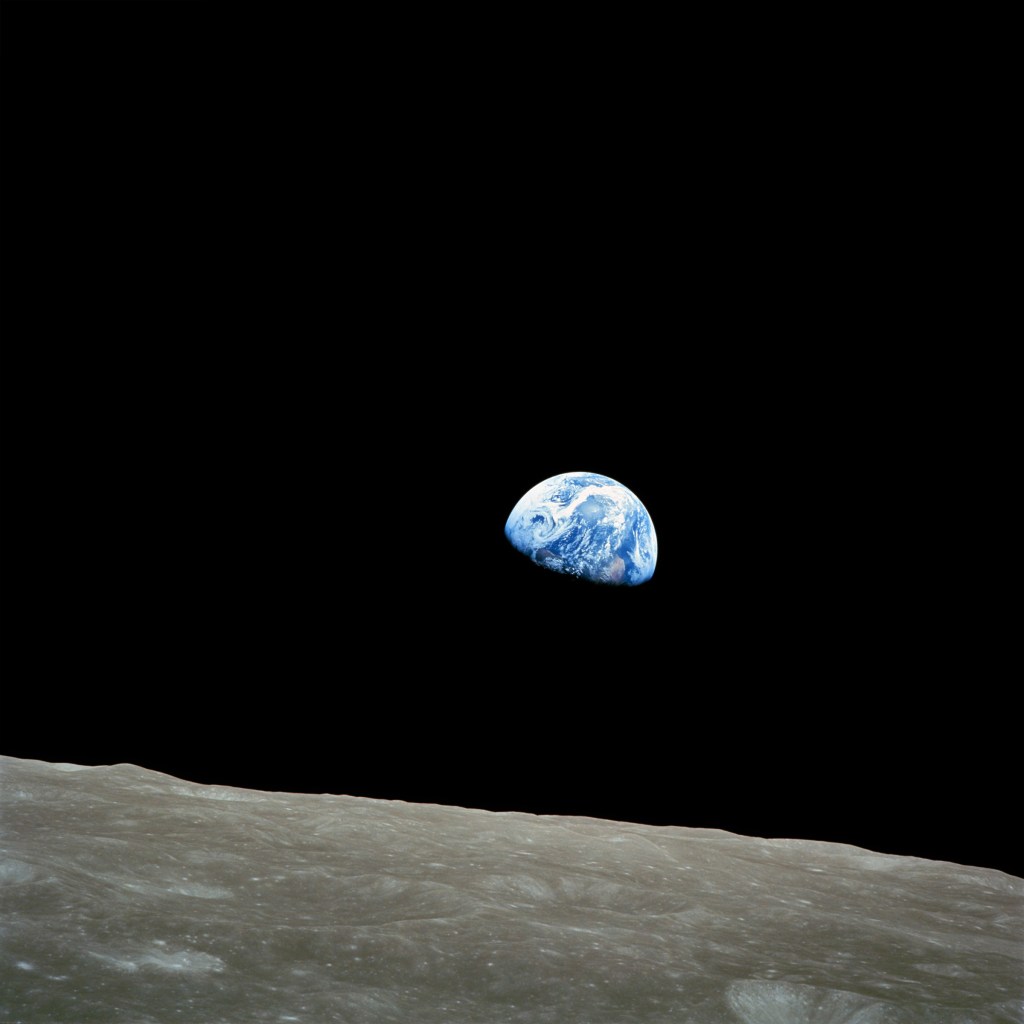
You are probably familiar with the famous photo “Earthrise,” taken in 1968 during the Apollo 8 mission to orbit the moon:
The photographer of that image, astronaut William Anders, died recently when the small plane he was piloting crashed in the water near the San Juan Islands. While I had seen the photo many times, I had not known the circumstances behind it (except, of course, that it was from space.) In reading about Anders in his obituary, I was struck by his reflection on the importance of the image he captured:
“Here we came all the way to the moon to discover Earth.”
Indeed. The image became iconic of the environmental movement, and is a reminder of the need to care for our shared planet. And in addition, it puts in perspective our human conflicts, how, on that one shared planet, we continue to oppress and fight one another and fail to provide to all our shared basic needs.
It is, therefore, a spiritual image, because it represents one of our preeminent spiritual values–humility. We are in relationship with and dependent upon the earth, and we are in relationship with and dependent upon each other. From space, we all appear equal.
Revisiting “Earthrise” served to reinforce two recent Torah passages that we recently read as part of our Shabbat reading cycle. We read them prior to Anders’s death, and when I read about the photo and Anders’s reflections upon it, it brought those passages into sharper focus.
Both are drawn from the end of the Book of Leviticus. The first is from the very end of the book. Leviticus ends with a series of warnings: if you fail to keep the covenant, then things won’t go well with you. The Torah is lengthy and explicit about the calamities that will befall the people should they fail to follow the guidelines and laws. When while on the one hand it can be supporting the difficult theology of divine reward and punishment, it could also be read as defining natural consequences.
Nowhere is this more stark then in the warning about keeping the “Sabbatical year.” According to Torah, just as humans take a rest every seven days with Shabbat, the land is supposed to take a rest every seven years. Every seventh year the land must be allowed to go fallow rather than be cultivated.
However the specific practice is carried out, the intention is clear: the land needs to rest just as much as we do. Just as we rest to take care of ourselves, so too do we let the land rest to take care of it.
And if we don’t: “For the land shall be forsaken of [the people], making up for its sabbath years by being desolate of them, while they atone for their iniquity; for the abundant reason that they rejected My rules and spurned My laws.” (Leviticus 26:43)
In other words, we must take care of the land, or the land will take care of us.
The other teaching is from the previous chapter. In this chapter we are introduced to the sabbatical year, as well as other guidelines for economic justice. Included in this is the need for fairness in the buying and selling of land. And we are taught, “But the land must not be sold beyond reclaim, for the land is Mine; you are but strangers resident with Me.” (Leviticus 25:23)
This powerful idea–that the land is not ours, we are just guests–is on the one hand another source for environmental consciousness. At the same time it is a source for interpersonal justice. If we remember that we are all but equal guests, then we must treat each other accordingly. If we remember that the land is not ours, then things like borders and nations become secondary. If we remember the land is God’s, then we must find a way for all to live upon it in peace.
“Earthrise,” then, can be seen as a graphic representation of these Torah passages. Our planet is fragile, our life upon it is fragile, and we have the opportunity to create the world as we want it.


 Rabbi 360
Thanks for continuing the conversation!