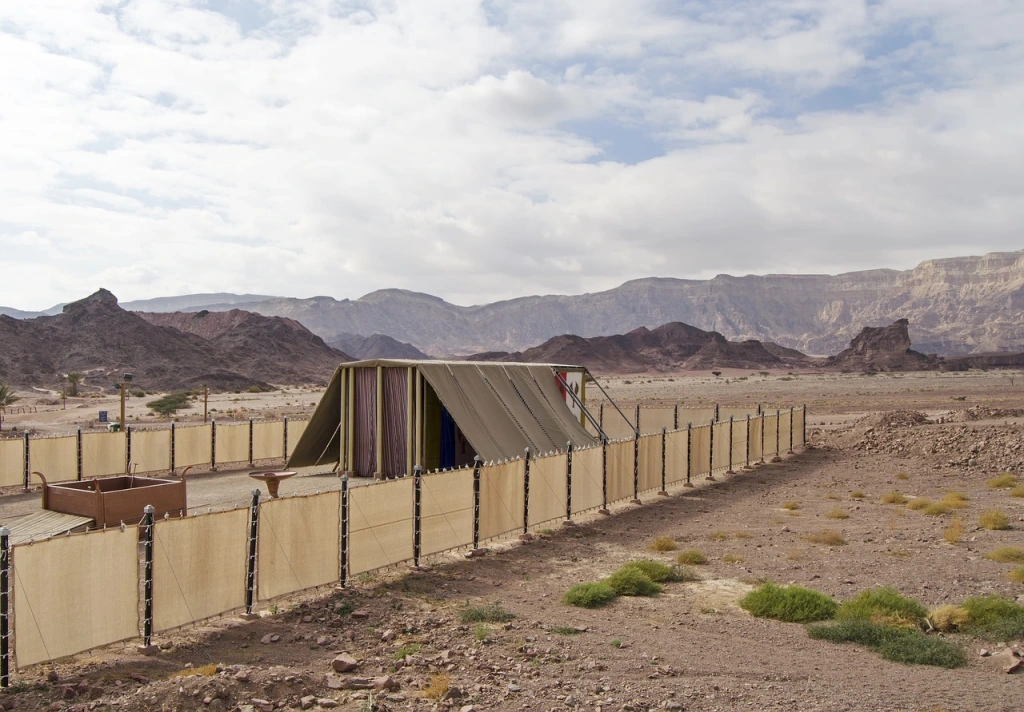
The past two weeks we have been reading in the Torah about the building of the mishkan (Tabernacle)—the portable structure that is to accompany the Israelites in their journey—as well as the furnishings and tools that were used for all of the various functions and sacrifices. We also read of the priests, their initiation, and particularly their garments.
On the one hand, a basic reading of the text serves to remind us that holy community needs holy space—that places to gather, to share, to connect, to support—are important. And over the past few years we have redefined what makes sacred space as we have introduced and maintained hybrid and virtual space, initially by necessity and now by desire.
But to just read it as a paean to community buildings would be an incomplete read of the mishkan. For we know that community transcends physical space.
In an analysis of the mishkan in his book The Heart of Torah, Rabbi Shai Held points out a number of parallels between the description of the mishkan and the Garden of Eden. Eden was and is in our spiritual imagination the place in the beginning of the book of Genesis that was home to the first humans, the beginning of life, the interconnectedness of species, and a place devoid of fear and want.
Numerous details align between the two places. Both the mishkan and the Garden of Eden have their entrance on the east. Both are overseen by cherubim, angelic figures found either by the entrance (Eden) or on top of the Ark of the Covenant (mishkan). The menorah that provided an eternal flame in the mishkan is decorated with plant symbols, while the center of the Garden was graced by the Trees of Life and Knowledge.
Thus the places are parallel, and so in building the mishkan, we are building Eden. A way to understand it now is that when we are commanded to build the mishkan, we are commanded to recreate Eden—we are commanded to build the world that we want and need. When we are instructed in the Torah to build the Tabernacle, we are being instructed to build a holy and just place for everyone. So as our heart continues to break for the devastation we humans are capable of, we can think about what our mishkan demands:
Our mishkan demands a ceasefire from everyone, everywhere, and that those taken against their will be returned to their families and homes.
Our mishkan demands the recognition of the humanity of all beings, and the realization that all loss of life is tragic.
Our mishkan demands the fulfillment of our basic human needs of sustenance and shelter, for one, but also the creation of the conditions that allow us to pursue our dreams.
Our mishkan demands the understanding of histories and narratives; that our futures are interconnected; that systems of oppression need to be broken, not replaced; that all people must be free; that we must care for and sustain the world that sustains us.
Our mishkan demands the investment in peace, not war; of negotiation, not violence; of prosperity, not devastation.
The elaborate description of the priestly garments in the Torah is instructive as well. For with all the focus on the clothing—the headdress, the cloak with bells and pomegranates sewn in the hem, the breastplate with precious stones representing the 12 tribes—we may tend to forget that underneath all that finery is a person. I empathize with the priests who may run the risk of having others not be able to see beyond the clothing to the person underneath, of being seen only as a role or title rather than as a human. And we know that writ large, unspeakable tragedy is possible when we are able to not see the full humanity of another.
Or to put it another way, I recently had occasion to articulate one of my core teachings for this moment, and I turned to the famous words of Hillel in Pirke Avot:
“If I am not for myself, who will be for me”: As a rabbi, as Jewish person, I am committed to the wellbeing, safety, survival and perseverance of Judaism and the Jewish people.
“If I am only for myself, what am I”: My commitment to my people also demands a commitment to the wellbeing, safety, survival and perseverance of others.
“If not now, when”: every moment is an opportunity to do what we can to bring peace and goodness into the world.

 Rabbi 360
Thanks for continuing the conversation!