You can watch me deliver this sermon here.
We gather once again at this time, and once again, we have an opportunity to look back and reflect on what lessons the past year has brought to inform our lives moving forward. And as you know, I do not just advocate for this work as a spiritual leader, but I engage in it as well.
Over these past years, I have brought you on Erev Rosh Hashanah a list of things that I have learned over the past year, based on a particular experience that I had. And this year, like most, I have a number of things I could have chosen.
There was the obvious turning 50, and the wisdom that comes from age and experience. There is the 20th anniversary of my ordination, though if you recall 10 years ago I shared what I learned from my 10 years in the congregational rabbinate, and I think a lot of the same lessons are still there. If you don’t remember, well I guess I could have saved myself a lot of work. There is the lessons I learned from the chaplaincy program I did this past year at the hospital and the decision to leave the program before I finished it. And that still may come at another time.
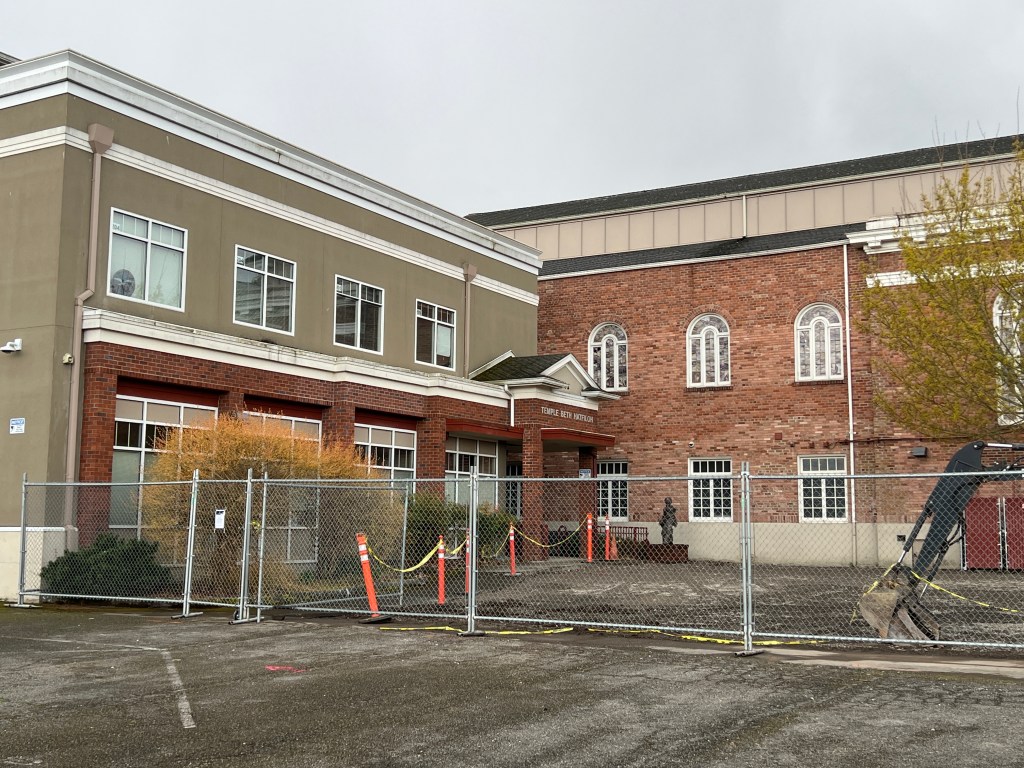
But no, this year I chose something else, something more prosaic perhaps, tangible, something visible, and something that we all perhaps have an experience of, something that is right outside these windows. Our courtyard project. Yes, the courtyard and parking lot.
Now, this is not a fundraising pitch, but a reflection. It would be easy to say this undertaking right outside these windows that you saw coming in is just a building project. But all throughout I’ve thought about how this project is really an outer physical manifestation of our values, our concerns, and our hopes for this community. And so on this Rosh Hashanah 5784, I present, the Seven Things I’ve Learned from our TBH Courtyard and Parking Lot Project.
1. Safety and Welcoming are not Mutually Exclusive
As you are probably aware, an initial impetus for the courtyard project was safety and security, and the fence is funded in part by a grant from the federal government designed for nonprofits who at are a particular risk. As a Jewish community, we unfortunately qualify.
This fence aims to incorporate best practices when it comes to security to create a two-tiered entry, and also to create one entry point.
Now I should say, that we have not been a target of direct threats or incidents, save for one swastika painting a number of years ago. But we are living in a time, especially post-Pittsburgh and the shooting at the Tree of Life synagogue, when anti-Semitism is on the rise, the rise of and increasing visibility and normalization of white supremacy particularly during the last Presidential administration has led to a rise in the rhetoric of anti-Semitism both in real life and online. I’ve experienced this on my social media. This is not something we should take lightly.
At the same time, we have to remember that we do not or should not need to sacrifice inclusivity and welcoming for the sake of safety. Indeed, by designing this the way that did, the security measures seem secondary to creating a welcoming space that we can use. That was intentional. What we have created here is something that provides safety without seeming like it does, allowing us to rely less on outward manifestations of security, like law enforcement or the presence of firearms on our property. Perhaps you might not have even realized that a security grant and plan was behind the fence. That is, to me, a success.
We need to be mindful and safe, but we should not sacrifice welcoming and inclusivity to all.
2. Challenges Can, and Must, lead to Creativity
Since the beginning of the Covid lockdown, we have had to fundamentally change how we do things as a community. It is a process that is still ongoing, we are still figuring out how to navigate this new reality. We have invested time and money into ensuring hybrid services, technology to be multi-access and to have best practices when it comes to the communal health of our community.
And this is something that we know, that we have all had to do this, we have all had to adapt in many aspects of our lives. And some of those adaptations are ones that are here to stay because while they might have been a reaction to Covid, they ultimately make things easier. The ability to have meetings or hold classes online, for example, has expanded so many opportunities. My Washington State rabbinic colleagues and I, for example, are now in the third year of an online-only Introduction to Judaism class that has on average attracted 80-100 students and is taught by 30 different rabbis from around the state.
And while the movement on the security grant and parking lot was already in place when the pandemic began, Covid became another motivation for the project. Outdoor gatherings became that much more important and attractive, so this became another way we can accommodate our community, and overall we can do more programs and events for all ages outside. (We are even expanding our WiFi coverage outside—its not done yet–so we can continue be multi-access programs from the courtyard).
I have noticed that shifts in attendance has not returned to what it was before the pandemic. At one point I thought that by this point we would have most people in the sanctuary on a Friday night with a few on Zoom. That has not been the case. So how we do Jewish community has changed, and we face that not with resignation, but with creativity. The courtyard is part of that creative response that we must have when we are facing new circumstances.
It is a lesson that we all must learn, challenging that it is: there is no “going back,” to how things were, there is only moving forward into what will be. Yet when we remember that moving into change allows us to be creative in ways we might not have been before, we can be excited for new possibilities. And tap into our creative selves that we might not have realized where there, or lay dormant. We can be more fully creatively expressive.
3. The Mezuzah is One of the Most Important Mitzvot
While the fence on the one hand serves the purpose of trying to prevent harm and is a way of turning inward as it was, at the same time, it expands our visibility here in Olympia, and is a way of turning out. And I have always felt that one of the ways we combat the forces of hate is by committing even more to our Jewish traditions and our community, and living more visibly Jewish. Jewish history has told us over and over again that we have continually outlived those who sought to do us harm.
Earlier this summer when we had our summer celebration of our community, my birthday and my tenure here at TBH, I presented the congregation with a gift—a mezuzah that we we will put on the gate of our new courtyard.
In the Shema, our liturgy that we chanted earlier, we are told, “You shall love Adonai your God with all your heart, with all your soul, and with all your might. Take to heart these instructions with which I charge you this day. Impress them upon your children. Recite them when you stay at home and when you are away, when you lie down and when you get up. Bind them as a sign on your hand and let them serve as a symbol on your forehead; inscribe them on the doorposts of your house and on your gates.”
These most sacred words and declaration which we recite drawn from the Torah, we are told to inscribe them on the door frames of our home. And that’s where we put the mezuzah, the little case with the inscription inside. But the Torah also says our gates, and so now that we have a gate, it is only fitting that we also put a mezuzah there. And specifically outwardly declare that this is a Jewish space.
The mezuzah, while a direct commandment from the Torah, carries with it multiple meanings. By putting these words on our homes, we are creating a sort of amulet, which provides a sense of protection and sanctity to our living spaces.
And the mezuzah serves as a form of Jewish identity—of identifying to the outside world that this is a Jewish home, a Jewish space. And in this age, we should be vocal, we should be visible. It feels to me that the practice of mezuzah then becomes that much more important. So we will have a mezuzah on our gate, and I invite you, if you do not have a mezuzah on your home, to place one. I’ll come and hang it with you. Let us honor our Jewish heritage by declaring it publicly.
4. The Jewish Community is Changing, So We Must Plan Accordingly.
The story of how we came about the parking lot and the courtyard was not due to some strategic plan to take over more real estate in downtown Olympia, but an opportunity that presented itself that we could not pass up. When the lot went on sale, and then when it was sold to another party, we had a limited opportunity to act to purchase the lot before we at best just lost our parking privileges and at worst we would have a building rise next to the synagogue.
But the opportunity was not just to find a place to park, but a means to help perpetuate Jewish life in Olympia for years to come. For this parking lot provides another source of income for the congregation and an investment in the future of this community to develop or whatever we choose to do with it.
There are trends across the Jewish community where many congregations are suffering from declining affiliation, a trend that we are actually avoiding, which is incredible. We are continuing to grow and add new households, and we are blessed with great support from our community. At the same time the ability to plan for the future is so necessary. We Jews, while always mindful of our past, we have also always been future focused to will be. L’dor v’dor, from generation to generation. Thinking forward as well as mindful of the past. This courtyard and parking lot now is a gift to future generations to meet the needs of the Jewish community, or the needs of others, the greater Olympia community, depending on what is done with it. And this is a way that we should approach all things that we do: taking care of our needs, and mindful of the legacy that we leave for others. In everything that we do: What is the legacy we are leaving for us. How can we be accountable to those who come after us? How can we answer for our actions to those who will follow? That is a kavannah, an intention, a powerful motivator for assessing what we do in the present.
And while we plan, we remember:
5. Der Mensch Tracht, Un Gott Lacht–Humans Plan and God Laughs
As you can see, the project is not yet finished, though getting close. Though initial hopes were that it would be completed by the time of the summer festival, or then by the High Holidays, things have a way of not going according to plan, as the Yiddish proverb says. We can plan, but sometimes there are greater forces at work that cause it so we are not able to get done what we hope to do.
There were so many moving parts in this project, that it should come as no surprise. Anyone who has been engaged with construction or renovation projects know that things don’t always go according to schedule. Life has a way of thwarting our best intentions. The beauty of this proverb is that it states a truth that we all understand, a norm, rather than an aberration or a deviation. One that we all recognize. Very often, things do go according to plan.
And the thing about the proverb as well that speaks truth that while is says Humans plan, God laughs—that is, the source of the frustration, the delay, the change—is beyond us, just as we posit God is beyond us. Whatever one’s idea of God, our theology we can understand that God is beyond our comprehension. God is not the same as humans, God is greater than each one of us. This proverb posits that the sources of our frustrations are beyond us.
Very often when things go wrong, we look for direct causality, we seek direct causality. If only X didn’t happen, then everything would be OK. Or everything was going smoothly until Y. Because we think that if we find a direct cause, then we have control, that can exert some semblance of control. But that’s the thing, we are never in control. There are so many moving parts, so many factors that go into any one plan in our lives, that to find one specific reason for a particular outcome, is an impossibility. And sometimes looking for a cause, and sometimes if we find it, it doesn’t change where we are, where we end up. The only choice, sometimes, is to accept that humans plan, and God laughs. And we plan again, this time with humility.
6. And because of this, Learning the Value of Patience
We have had to be patient when it comes to the courtyard, which is a good reminder that patience—savlanut—is one of the middot, or character traits, that the Jewish school of Mussar teaches. Mussar builds spiritual practice around the development and cultivation of middot, through learning and practice. And the courtyard is giving us practice in savlanut.
Having been a rabbi now for 20 years, and serving this congregation for 20 years, it provides a unique perspective. Looking back, I can see that we are not the same congregation now that we were then, than we were then. And how that has come about has been a 20-year process. I think about my own role, my own rabbinate here. Ideas that I had walking in, some I put into place soon after I arrived, some I abandoned, some are coming to life only now, after years of connection, relationship building, planning, and taking small steps.
One of the factors we neglect often in our desire to make change—whether for ourselves, or our communities—is time. Bringing people together takes time. Bringing others with us on our quests takes time. Sometimes giving ourselves the space to make change takes time. And with time, comes the need patience.
There is a story in our tradition I love about Rabbi Akiva (Pirke de Rebbe Natan 6:2). And Rabbi Akiva is one of the great sages of the Talmud, and it is said he didn’t start studying until he was 40 years old. And it was said once he was standing at the mouth of a well, and he said, “who carved this hole in the stone? Who carved it? How did it get here?” And the others around him said it was from the water. The dripping water. That each drop of water slowly wore away the stone. And Rabbi Akiva saw this and he applied it to himself, that if water, little drops of water, something so soft can carve the hard stone, then words of Torah can penetrate my heart. And when he started didn’t matter, how long it took didn’t matter, but just the idea each step, each drop of water ultimately carves away the stone, was a lesson in patience.
It may take time in the changes we wish to make in our lives, but our hearts will eventually open. Patience, and things will be made manifest.
One of the maxims that I tend to think about often with regard to community work, or social justice is, “we overestimate what can be accomplished in the short term and underestimate what can be accomplished in the long term.” It is hard sometimes, for we want to see change happen immediately. Sometimes it needs to happen immediately and sometimes it does happen immediately. And when it doesn’t, there is so often that possibility to get frustrated and impatient and want to walk away. But the Jewish middah of savlanut reminds us that with time, and patience, change will most certainly come.
7. Each One of Us Has Our Role to Play
Since my office here at the synagogue looks right out on the courtyard, I’ve had a front row seat to the construction. And I admit it has been fascinating to watch. I’ve been so interested in watching the various contractors and subcontractors work– I wonder, but doubt, that they had as much interest in watching me work as I had in watching them work.
And so many different specialists, from the ones who poured the concrete, to the masons who build the columns, to the fence contractor, to the asphalt, to the electricians who laid the conduit and pulled the wire. And on and on. Each with their own unique role to play and skills to contribute.
It took each one to do their part to make the courtyard come together. Each one was necessary towards the completion of the whole. And it was a good reminder that, especially in a society that creates hierarchies of skill sets, that everyone, everyone has their gifts. Everyone has their impact and their role to play.
One of my favorite teachings for Pirke Avot, the ancient Jewish ethical text, is:
אַל תְּהִי בָז לְכָל אָדָם, וְאַל תְּהִי מַפְלִיג לְכָל דָּבָר, שֶׁאֵין לְךָ אָדָם שֶׁאֵין לוֹ שָׁעָה וְאֵין לְךָ דָבָר שֶׁאֵין לוֹ מָקוֹם
Do not disparage anyone, and do not shun anything. For everyone has their hour, and everything has its place. (Pirke Avot 4:3)
Each one of us is unique, special, talented, and worthy. Each one of us has our hour. Each one of us has our place. All the moreso does that become apparent when we join together to create something exceptional and special. And this is where the courtyard and the parking lot is really just a vessel, a container. It is a vessel for us. It is a container for this community.
In this community, each one of you has something to contribute, to share, to teach, and to learn. We are all uplifted by our diversity of experience, background, and ideas. And we work best as a community, as a congregation, when we are able to show up, and show up for each other.
Community, Jewish community, is not easy. There will be people who disagree with you, who see things differently, who have different styles, and different priorities. The organization as a whole may let you down from time to time, I’m sure I have let you down from time to time. And yet, it so important to continue to commit and connect. We grow by experience and encounter, and if we do not show up, we are denying ourselves and others the opportunity to learn and teach, to share and grow. We have something to teach each other and we have something to learn from each other. When we don’t show up, we deny that possibility.
Since I arrived 20 years ago, we have grown our footprint, from three blocks away, to here, to our addition, and now a parking lot and a courtyard. It is exciting to see. But more than that, it is exciting to know, that this space that we are creating is holy, not just because of what it is, an extension of our synagogue, but because of what it represents: safety, creativity, Jewish identity, adaptability, accessibility, inclusivity, humility, patience, and community.
May this holy space inspire us to grow in spirit, compassion, and love–for us, for our Jewish community, and for all peoples.
(And here is a link to that scene in A Serious Man to which I made an offhand reference.)

 Rabbi 360
Thanks for continuing the conversation!