This week we read parashat Shoftim in the Torah, in which we are reminded of the importance of tzedek, or justice. And this week we usher in the new month of Elul, in which we are reminded of the importance of teshuvah, or repentance.
The two concepts are interconnected, for one of the ways that we enact repentance on a communal level is through the pursuit of justice.
Justice takes many forms. Sometimes it involves direct punishment of those who committed crimes. We see that in the parashah as we learn rules for the procedures of judges and courts as well as specific outcomes for specific offenses.
And sometimes it involves making societal changes in order to correct for past wrongs in which the people who originated the injustice can not be addressed directly, but the lingering effects of the injustice can be.
As Jews, we are well acquainted with injustice and oppression, not only because our sacred texts speak of them and our obligation to remedy them, but because throughout our history to the present day we have been the victims of hatred, violence, and discrimination.
And as Americans, we are well aware that our country has throughout history and to the present day perpetrated violence, discrimination and oppression particularly against people of color. The founding of this country was built upon the genocide of the indigenous population as well as the free labor of Black slavery, the effects of which persist to this day, and, one could argue, still exist in different forms.
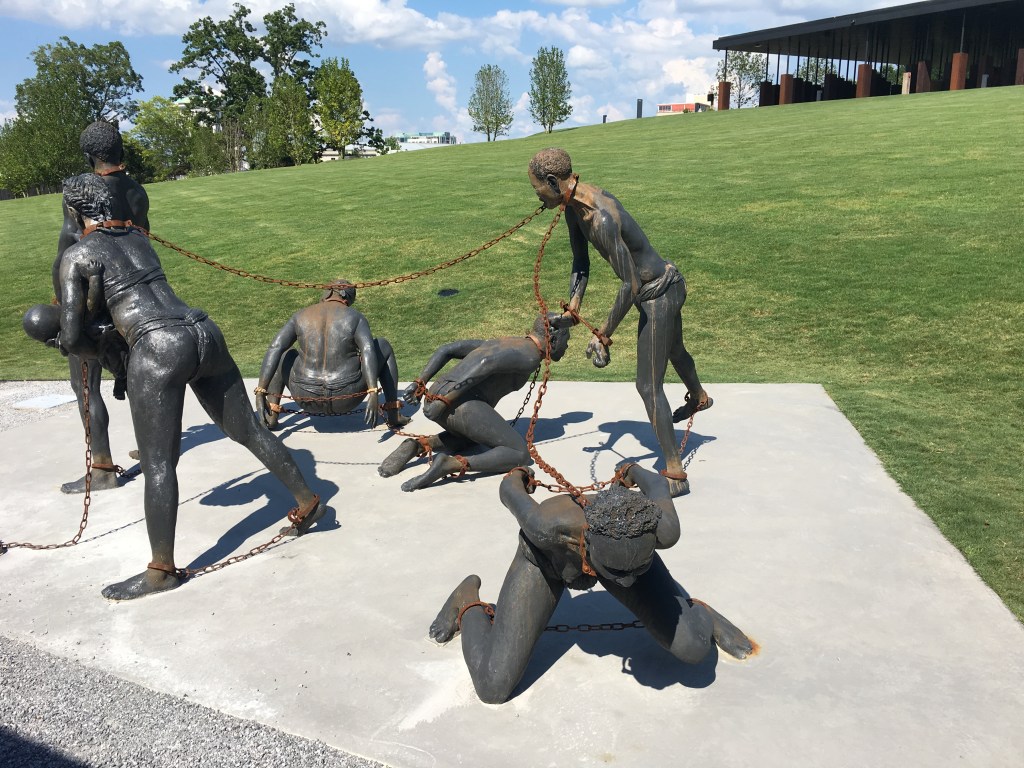
[The Legacy Museum in Montgomery, Alabama, which I visited a few years go, explicitly and compellingly traces the direct connection from slavery to lynching to Jim Crow to mass incarceration.]
In response to this legacy, there has developed a growing national movement for reparations for those who still suffer these effects of this, particularly of chattel slavery. And in light of our history, and in keeping with our values of teshuvah, of needing to atone for and rectify past wrongs, and of tzedek, of a justice that leads to wholeness and repair, Jewish communities are heeding this call.
Recently, the Reconstructionist Movement, joining the Reform Movement, passed a resolution on reparations that reads in part:
Whereas the pervasiveness of white supremacy and the generational trauma it has inflicted on BIPOC communities over hundreds of years mean that there is no redress sufficient to fully repair the foundational harms caused by colonialism, slavery, and the ongoing manifestations of
these systems; such harms, which have resulted in the current power and prosperity of the United States – among other nations – still require repair, as articulated by the growing national movement for reparations;
At Temple Beth Hatfiloh, a number of our members have recently formed a Reparations Task Force to examine reparations within our community. In keeping with the season of Elul and the High Holidays, a time of introspection, reflection and repair, the Task Force will be hosting two learning sessions on Sunday, August 20 and Sunday, September 10 from 4-6 pm both in person and online. More information can be found here. These are important opportunities to learn particularly about a Jewish approach to reparations. (Other resources can be found on the Reconstructionist Movement website here.)
One of the most compelling teachings from Jewish tradition I have learned on this subject is not about the values of teshuvah and tzedek per se, but a specific discussion in the Talmud that talks of stolen property. What if someone stole a wood beam and then incorporated it into a building. What do you do? How to you compensate the person whose beam was stolen? As usual, the Talmud presents a disagreement.
The Sages taught: If one robbed another of a beam and built it into a building, Beit Shammai say: He must destroy the entire building and return the beam to its owners. And Beit Hillel say: The injured party receives only the value of the beam but not the beam itself.
Babylonian Talmud, Gittin 55a
This text has been offered by Rabbi Sharon Brous and others as a powerful Jewish metaphor for thinking about reparations. Namely: our country was built on a stolen beam, and we need to find a way to compensate those who have been robbed.
The work of introspection, of examination, of teshuvah is not easy, and yet so necessarily, both on the individual and the communal level. And, in recognizing the difficulty and the vulnerability that comes with it, our tradition teaches that this work is something we are invited to do in community, supporting one another in this important work. We have the opportunity now to think about reparations as a community.
And we should, for as we are reminded in this week’s Torah portion, teshuvah can also involve the pursuit of justice. That verb is not accidental; the famous teaching from the Torah this week is “tzedek, tzedek tirdof“–justice, justice, you shall pursue. In other words, justice will not come unless we actively work for it.


 Rabbi 360
Thanks for continuing the conversation!